
|
Course |
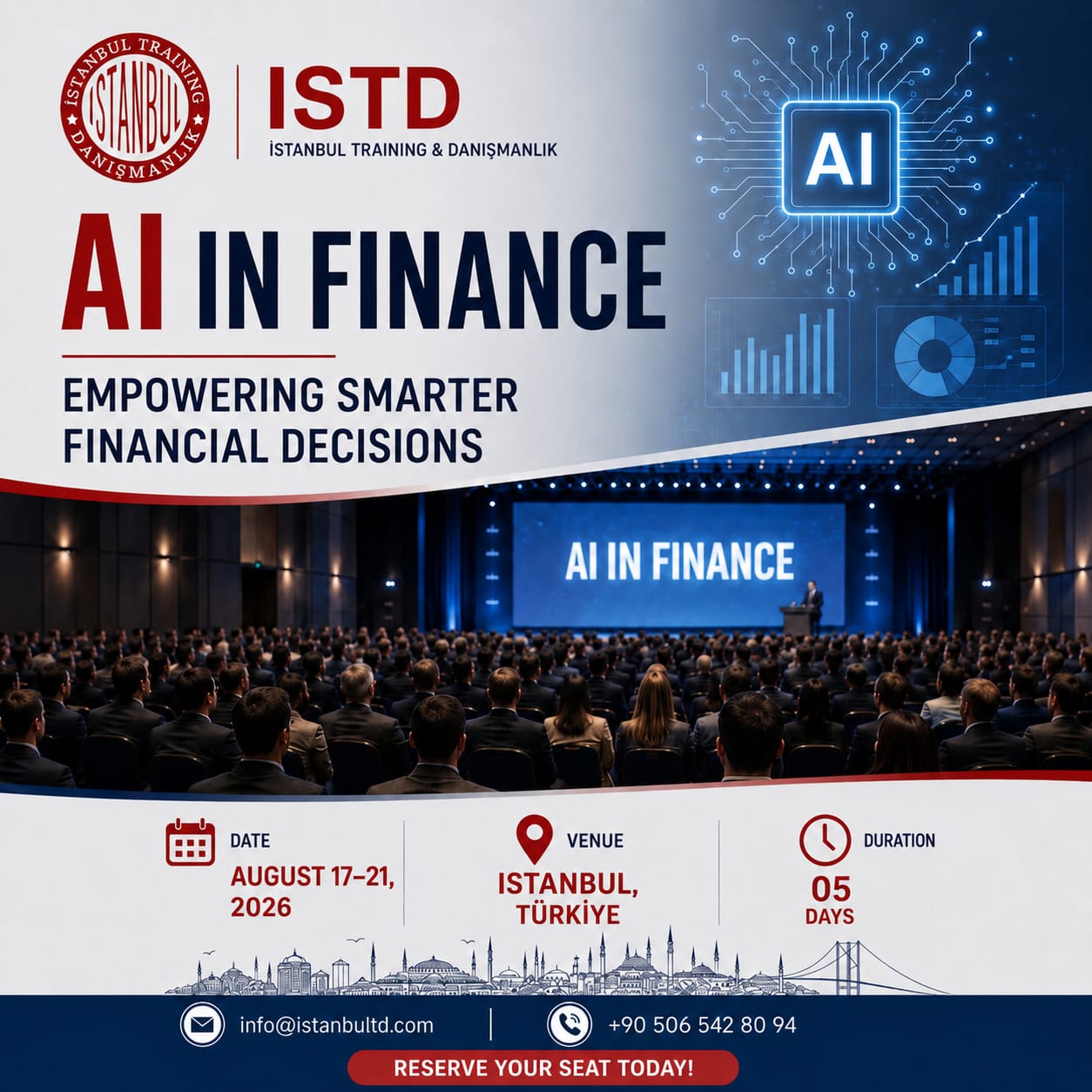
AI in Finance: Empowering Smarter Financial Decisions |
|
Duration |
05 Days |
|
Date |
August 17-21,2026 |
|
Venue |
Istanbul, Türkiye |
|
Investment |
2,590 USD |
|
|
|
|
|
+90 506 542 80 94 |
Course Overview
This course is designed for finance professionals, accountants, auditors, analysts, managers, executives, and decision-makers who want to understand how Artificial Intelligence can improve financial planning, forecasting, reporting, risk management, fraud detection, compliance, and strategic decision-making.
The program focuses on practical AI applications in finance, helping participants understand how AI can support faster analysis, better accuracy, stronger controls, and more data-driven financial decisions.
Course Objectives
By the end of this course, participants will be able to:
- Understand the role of AI in transforming finance functions.
- Identify practical AI applications in accounting, budgeting, forecasting, and reporting.
- Use AI-supported tools for financial analysis and decision-making.
- Improve financial planning and forecasting through data-driven insights.
- Understand how AI supports fraud detection, risk management, and compliance.
- Apply AI concepts to budgeting, cost control, and performance monitoring.
- Recognize ethical, governance, and data privacy issues in AI-driven finance.
- Develop a practical AI adoption roadmap for finance departments.
Personal and Organizational Impacts
Personal Impacts
Participants will gain:
- Stronger confidence in using AI for finance-related tasks.
- Better understanding of AI tools for financial analysis.
- Improved ability to interpret financial data and trends.
- Practical knowledge of AI-supported forecasting and reporting.
- Enhanced decision-making skills for finance roles.
- Readiness to support digital finance transformation.
Organizational Impacts
Organizations will benefit from:
- Faster and more accurate financial reporting.
- Improved budgeting and forecasting quality.
- Better financial risk identification.
- Stronger fraud detection and internal control.
- More efficient finance operations.
- Improved strategic decision-making.
- Enhanced transparency, compliance, and accountability.
Course Outline:
Foundations of AI in Finance
Module 1: Introduction to AI and the Future of Finance
- What AI means for finance professionals
- Key AI concepts in simple business language
- How AI is changing the finance function
- Opportunities and challenges for finance teams
Module 2: Digital Finance Transformation
- Traditional finance vs. AI-enabled finance
- Moving from manual reporting to intelligent finance
- Finance automation and decision intelligence
- Building an AI-ready finance mindset
Module 3: Practical AI Use Cases in Finance
- Financial analysis
- Forecasting and planning
- Fraud detection
- Risk management
- Reporting and dashboards
Module 4: Financial Data as the Foundation of AI
- Importance of reliable financial data
- Common financial data sources
- Data quality and accuracy issues
- Preparing financial data for AI tools
Module 5: Responsible AI, Ethics and Governance in Finance
- Bias and errors in AI-supported decisions
- Transparency and explainability
- Human review and accountability
- Governance principles for AI in finance
AI for Financial Planning, Budgeting and Forecasting
Module 6: AI in Financial Planning and Analysis
- Role of AI in FP&A
- Automating financial analysis
- Identifying patterns and trends
- Supporting strategic finance decisions
Module 7: AI-Supported Budgeting
- Improving budget preparation
- Historical data analysis
- Budget assumptions and scenario planning
- Reducing manual budget errors
Module 8: AI for Forecasting and Predictive Analysis
- Revenue forecasting
- Expense forecasting
- Cash flow forecasting
- Predictive financial modeling
Module 9: Scenario Analysis and Decision Support
- Best-case and worst-case scenarios
- Sensitivity analysis
- What-if financial analysis
- AI-supported management decisions
Module 10: AI for Cost Control and Resource Optimization
- Cost pattern analysis
- Identifying cost-saving opportunities
- Expense monitoring
- Resource allocation decisions
AI in Accounting, Reporting and Performance Management
Module 11: AI in Accounting Operations
- Automating repetitive accounting tasks
- Invoice processing and reconciliation
- Journal entry review
- Reducing manual processing time
Module 12: AI for Financial Reporting
- Automated report generation
- Real-time financial reporting
- Management reporting automation
- Improving report accuracy and consistency
Module 13: AI Dashboards and Financial Insights
- Building finance dashboards
- Visualizing key financial indicators
- Turning data into insight
- Executive-level reporting
Module 14: AI for Performance Monitoring
- Financial KPI tracking
- Variance analysis
- Profitability analysis
- Departmental performance monitoring
Module 15: AI in Audit Support and Internal Control
- Control testing support
- Exception detection
- Transaction monitoring
- Strengthening internal controls
AI for Risk, Fraud Detection and Compliance
Module 16: AI in Financial Risk Management
- Identifying financial risk indicators
- Market, credit, liquidity and operational risk
- Early warning signals
- Risk-based decision-making
Module 17: AI for Fraud Detection
- Detecting unusual transactions
- Pattern recognition in financial fraud
- Red flags and anomaly detection
- Fraud prevention strategies
Module 18: AI in Compliance and Regulatory Reporting
- Compliance monitoring
- Automated regulatory reporting
- Reducing reporting errors
- Supporting transparency and accountability
Module 19: AI for Cash Flow and Liquidity Management
- Cash flow prediction
- Liquidity monitoring
- Working capital optimization
- Payment and collection insights
Module 20: Cybersecurity and Data Protection in AI-Driven Finance
- Financial data security risks
- Protecting sensitive financial information
- Access control and confidentiality
- Data privacy considerations
AI Strategy, Implementation and Finance Transformation Roadmap
Module 21: Selecting AI Tools for Finance
- Criteria for choosing AI finance tools
- Vendor evaluation checklist
- Integration with accounting and ERP systems
- Cost, scalability and risk considerations
Module 22: AI Implementation in Finance Departments
- Identifying priority use cases
- Pilot testing and gradual implementation
- Roles and responsibilities
- Measuring implementation success
Module 23: Change Management for AI in Finance
- Managing staff concerns
- Building trust in AI tools
- Training finance teams
- Communicating AI benefits clearly
Module 24: Developing an AI Governance Framework for Finance
- AI policies and procedures
- Human oversight and approvals
- Risk controls for AI outputs
- Accountability for financial decisions
Module 25: Building an AI Roadmap for Smarter Financial Decisions
- Short-term and long-term AI goals
- Finance transformation priorities
- Success indicators and performance measures
- Action plan for implementation
Training Methodologies
The course will use a practical and interactive learning approach, including:
- Expert-led presentations
- Group discussions
- Case studies
- Finance scenario exercises
- AI tool demonstrations
- Practical worksheets
- Group assignments
- Problem-solving activities
- Action planning sessions
Main Takeaways
Participants will leave the course with:
- Clear understanding of AI applications in finance.
- Practical knowledge of AI-supported budgeting, forecasting and reporting.
- Ability to identify AI opportunities in finance operations.
- Better understanding of AI in risk, fraud detection and compliance.
- Stronger ability to use data for smarter financial decisions.
- Awareness of ethical, governance and data privacy issues.
- A practical roadmap for AI adoption in finance departments.